
Finger and Hand Joint Pain: Heberden's Nodes, Hand OA or RA?

By Dr. Krishna Adhikari, Consultant Rheumatologist
MBBS, MD (Internal Medicine), Fellowship in Clinical Rheumatology
Awaiting medical review: this new article has not yet been checked by Dr. Krishna Adhikari. It will be updated after his review.
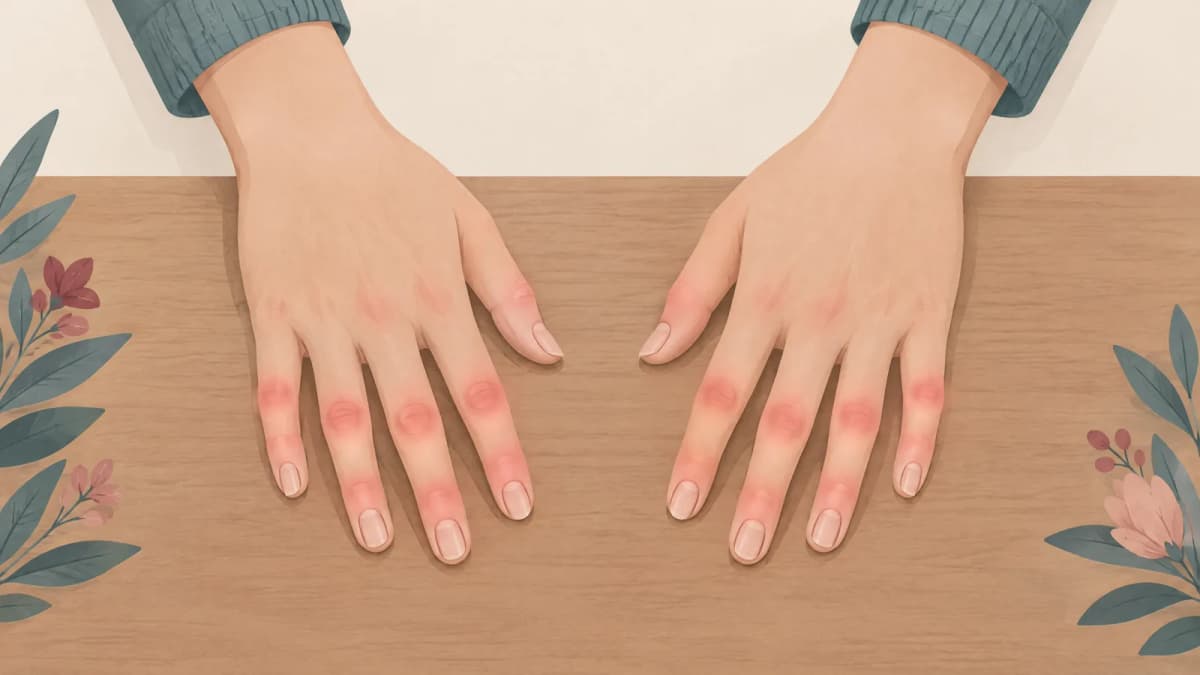
Finger and hand joint pain is often osteoarthritis (OA), the most common form of arthritis, but rheumatoid arthritis (RA), psoriatic arthritis and gout can also affect the hands, and which joints hurt is a key clue. Pain at the joints nearest the fingertips or at the base of the thumb, often with hard bumps (Heberden's nodes) at the fingertip joints, points towards osteoarthritis; painful, swollen knuckles and wrists, usually on both hands, with morning stiffness lasting more than 30 minutes, point towards rheumatoid arthritis. Only an examination can decide.
Which finger joints hurt, and what does the pattern suggest?
Patterns overlap, so this is a guide, not a diagnosis.
Osteoarthritis: the joints closest to the fingernails, the middle finger joints and the base of the thumb; the large knuckles where the fingers meet the hand are less often affected (NHS; Arthritis UK).
Rheumatoid arthritis: the small joints of the hands and feet, often on both sides at once (NHS), including the knuckles, middle finger joints and wrists, but rarely the fingertip joints (MSD Manual).
Psoriatic arthritis: swelling of a whole finger, sometimes with nail changes (NIAMS).
Gout: sudden severe pain, heat and swelling in one joint, usually the big toe, sometimes in the hands (NHS).
What are Heberden's nodes and Bouchard's nodes?
Nodes are firm, knobbly bumps at the finger joints, caused by bony spurs called osteophytes (Arthritis UK). Heberden's nodes form at the joint closest to the fingertip and Bouchard's nodes at the middle joint; both are signs of osteoarthritis of the hand (Cleveland Clinic). Because rheumatoid arthritis rarely affects the fingertip joints (MSD Manual), a bump there is not its usual pattern. The joints may be stiff, painful and swollen, but nodes can also be painless (NHS; MSD Manual).
Who gets hand osteoarthritis, and do the bumps go away?
It is more common in women over 50 and often starts around the menopause; genes, earlier injuries and years of repetitive tasks make it more likely (Arthritis UK). The bumps tend to stay, but the pain often eases: it may be painful for a few years and then improve, especially if only the small finger joints are affected, though movement does not always recover (Arthritis UK); the pain may even disappear while bumps and swelling remain (NHS). People with nodes are more likely to develop knee osteoarthritis too, though many never do (Arthritis UK; see our knee osteoarthritis guide).
How does rheumatoid arthritis of the hands differ?
In the hands, rheumatoid arthritis causes throbbing, aching pain, swelling, warmth and tenderness in small joints, typically on both sides though not always, sometimes with trouble making a fist (NHS). Knuckle and wrist involvement is frequent in RA but unusual in OA (although OA at the base of the thumb is sometimes felt as wrist pain), and RA swelling is mainly soft rather than bony (MSD Manual). Morning stiffness is a clue: in OA it usually wears off within 30 minutes, in RA it often lasts longer (NHS). See our rheumatoid arthritis guide.
What about psoriatic arthritis, gout, trigger finger and carpal tunnel syndrome?
Psoriatic arthritis can cause painful, sausage-like swelling of a whole finger and nail changes such as tiny dents or crumbling (NIAMS). Most people already have the skin disease psoriasis, but a small group have joint pain first (NIAMS). It may look like osteoarthritis and no blood test is available for it at present, so a doctor may ask about skin problems in you or your family (Arthritis UK).
Gout can affect the hands as well as the big toe (NHS), including the fingertip joints, where it can resemble nodal osteoarthritis (MSD Manual). Long-untreated gout can form hard lumps (tophi) under the skin, usually on the ears, fingers or elbows (NHS). See our gout and uric acid guide.
Trigger finger is a finger or thumb that gets stuck bent, clicking as it straightens. Carpal tunnel syndrome is pressure on a wrist nerve that causes tingling, numbness and pain in the hand, usually worse at night (NHS). The first is a tendon problem and the second a nerve problem, so they are usually handled by a doctor, physiotherapist or hand therapist, then other specialists if treatment fails (NHS; HSS). Trigger finger is more likely with rheumatoid arthritis, and carpal tunnel syndrome with arthritis (NHS), so mention swollen joints.
How does a doctor find the cause?
A doctor asks about your symptoms and examines your hands (NHS; Arthritis Foundation), and hand osteoarthritis can often be diagnosed this way without tests (Arthritis UK). If there is doubt, blood tests help: ESR and CRP assess inflammation (see our ESR and CRP guide), and RA factor and anti-CCP are used for rheumatoid arthritis (see our RA factor and anti-CCP guide), though no blood test can prove or rule it out (NHS). A urate test is used if gout is suspected, and joint fluid can be tested if the result is unclear (Arthritis UK; NHS). X-rays can show lost joint space and bone spurs (Arthritis Foundation); when rheumatoid arthritis is suspected, X-rays of the hands and feet are advised (NICE).
What can I do at home?
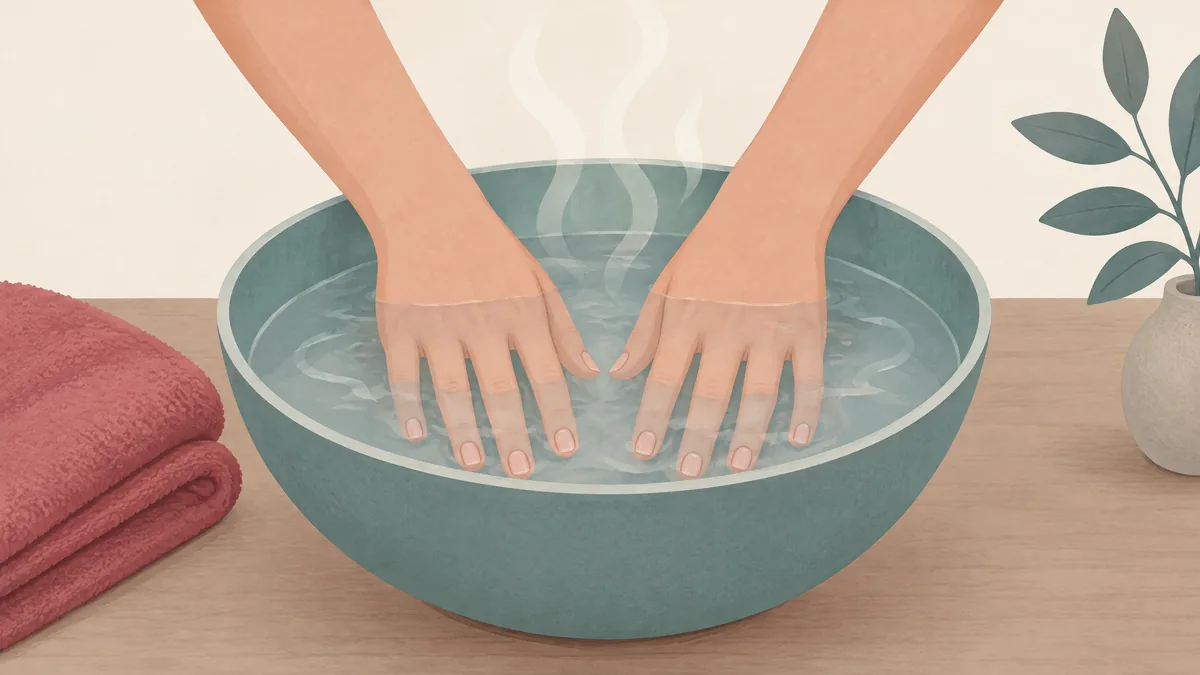
These steps are for hand osteoarthritis; get the cause checked first. A hot, red, swollen joint is a warning sign (see below). Pain medicines, injections and surgery are for a doctor to decide.
Keep moving: exercise can ease stiffness and improve grip strength, though less clearly pain (Arthritis UK). Ask a physiotherapist or hand therapist, warm the hand first and avoid exercises that cause a lot of pain (Arthritis UK; Cambridge University Hospitals).
Protect the joints: use bigger joints (carry bags on the forearm or in a backpack), use more joints (both hands), use gadgets, and pace tasks with breaks (Cambridge University Hospitals; Arthritis UK).
Use warmth or cold: warm water can ease morning stiffness, and a wrapped ice pack for no more than 20 minutes may help swelling (Arthritis UK).
Consider a splint or gloves: for osteoarthritis at the base of the thumb, a thumb splint may help pain and function over time, but not all the time, as that could weaken the hand (Arthritis UK). The American College of Rheumatology also conditionally recommends splints for the thumb base and finger joints, and arthritis gloves.
हात र औंलाको जोर्नी दुख्ने: नेपालीमा संक्षेप
हात र औंलाका जोर्नी दुख्ने कारण ओस्टियोआर्थराइटिस, रुमाटोइड आर्थराइटिस, सोरियाटिक आर्थराइटिस वा गाउट हुन सक्छन्। कुन जोर्नी दुख्छ, त्यो एउटा संकेत मात्र हो; डाक्टरले जाँचेर मात्र निदान गर्छन्।
ओस्टियोआर्थराइटिसमा औंलाका जोर्नीमा कडा गाँठा देखिने हुन सक्छ। दुखाइ समयसँगै कम हुन सक्छ, तर गाँठा भने रहन सक्छन्। रुमाटोइड आर्थराइटिसमा हात, नाडी र खुट्टाका साना जोर्नी दुख्ने, सुन्निने र छुँदा दुख्ने, प्रायः दुवैतिर एकैसाथ हुन्छ, र बिहान ३० मिनेटभन्दा बढी कडा हुन सक्छ। औंला सुन्निने समस्या सोरियाटिक आर्थराइटिस र गाउटमा पनि हुन सक्छ।
कारण छुट्याउन डाक्टरले जोर्नी जाँच गर्नुहुन्छ र रगत जाँच वा एक्स-रे गराउन सक्नुहुन्छ। जथाभाबी औषधि नखानुहोस्, डाक्टरको सल्लाह लिनुहोस्।
जोर्नी दुख्ने, सुन्निने वा कडा हुने समस्या ठीक नभएमा, वा बिहान ३० मिनेटभन्दा बढी कडा भइरहेमा, बाथ रोग विशेषज्ञ (रुमाटोलोजिस्ट) लाई देखाउनुहोस्। कुनै एउटा जोर्नी अचानक धेरै दुखेर सुन्निएको, तातो वा रातो भएको छ, वा जोर्नी दुख्दा ज्वरो आएको छ भने तुरुन्तै डाक्टरलाई देखाउनुहोस्।
When to see a rheumatologist
Warning signs first. Joint pain with swollen skin that feels hot, or with a high temperature, feeling unwell or feeling hot, cold or shivery, needs urgent medical care and can be a joint infection (NHS): see a doctor the same day, or go to a hospital emergency department if you cannot be seen quickly. Go to a hospital emergency department straight away after very bad pain from a fall or injury, a joint that has moved out of place, or tingling or no feeling around the joint after an injury (NHS).
See a doctor if joint pain or swelling keeps coming back or is getting worse, stops you doing normal activities, has not improved after 2 weeks at home, or if joints are stiff for more than 30 minutes after waking (NHS). Also go for bumps at the end joint of a finger or trouble with fine tasks (Cleveland Clinic), or a finger that keeps getting stuck bent, or numbness, tingling or a weak grip that is getting worse or not going away (NHS). The UK's NICE advises doctors to refer adults with suspected persistent synovitis (inflammation of the joint lining; NIAMS) for a specialist opinion, urgently if the small joints of the hands or feet or more than one joint are affected, or if 3 months or more passed before advice was sought. These are rules for doctors, not self-diagnosis. Swollen fingers with psoriasis or nail changes also need checking, as early treatment of psoriatic arthritis is linked to better outcomes (NIAMS). Long-lasting joint problems are often called bath rog in Nepali; see our bath rog guide.
Rheumatology care in Kathmandu Valley
Rheumatology care at Tulsi Multi Speciality Clinic is provided by Dr. Krishna Adhikari, consultant rheumatologist and Lecturer in Internal Medicine at Patan Academy of Health Sciences (Patan Hospital), NMC No. 13049. He consults Sunday to Friday from 4:00 PM at AVM Chowk, Manbhawan, Lalitpur-5, Kathmandu Valley. See our rheumatology service and Dr. Krishna Adhikari's profile, book an appointment, or call +977-1-5914294. This article is general information, not a substitute for a consultation.
Sources
Rheumatology care at Tulsi Multi Speciality Clinic · Dr. Krishna Adhikari, consultant rheumatologist
To see a doctor, book online, call +977-1-5914294 or message the clinic on WhatsApp.